
GroceriesReview.co.uk provides independent reviews and recommendations. Some pages contain affiliate links to Amazon.co.uk, and we may earn a commission when you make a qualifying purchase at no extra cost to you.
Tea starts as a simple leaf, yet ends up tasting wildly different depending on what happens in the hours after picking. The same plant can produce brisk black tea, fresh green tea, and fragrant oolong. That transformation is not magic, it’s process.
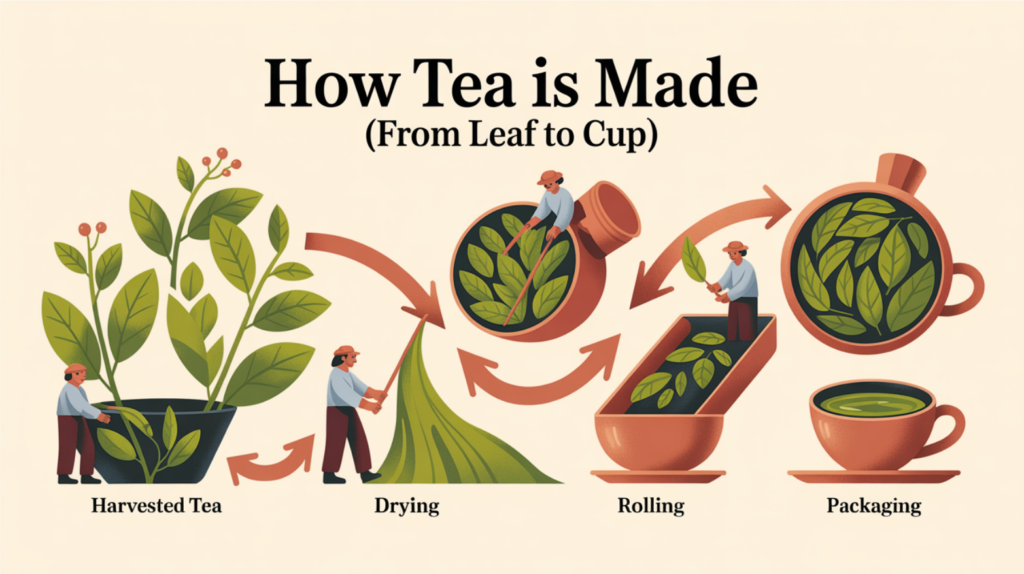
Tea is made from the leaves of the tea plant. Once those leaves are picked, the clock starts. Moisture begins to shift, enzymes start reacting with oxygen, and aroma compounds develop. Every decision after harvest shapes what you eventually taste in the mug.
If you’ve ever wondered why black tea bags feel bold while green tea tastes lighter and greener, the reason is largely found in the steps below.
The tea journey in plain steps
Most “true teas” (black, green, oolong, white) follow the same broad path:
- Picking
- Withering
- Shaping (rolling or cutting)
- Oxidation control (either allowed, slowed, or stopped)
- Drying
- Sorting and packaging
- Brewing
The difference between tea types isn’t the plant. It’s how these steps are handled.
A quick snapshot: what changes between black, green, oolong, and white
| Tea type | What’s happening to the leaf | Oxidation level (simple view) | Typical taste direction |
|---|---|---|---|
| Green tea | Heat is applied early to stop browning | Low | Fresh, vegetal, clean |
| Oolong | Leaf is gently bruised and partially browned | Medium (variable) | Floral, creamy, toasted |
| Black tea | Leaf is fully browned before drying | High | Malty, robust, brisk |
| White tea | Minimal handling, slow natural drying | Very low to low | Soft, delicate, light |
This is why black tea and green tea feel so different even though they start in the same garden.
Step 1: Picking the leaves
Tea is usually harvested from the top growth of the plant. The youngest leaves carry the most delicate flavour potential. In many traditional styles, the pick is kept small and tender, which helps produce a more aromatic cup later.
What happens here matters because:
- younger leaf material tends to taste smoother
- older leaves can lean thicker and more coarse
- careful plucking reduces bruising before processing even begins
Step 2: Withering (the leaf relaxes)
Freshly picked leaves contain a lot of water. Withering reduces moisture and softens the leaf so it can be shaped without cracking.
Think of withering as the moment the leaf becomes flexible. This stage also begins subtle flavour development because the leaf’s chemistry starts shifting as it loses water.
Withering can last hours, and it’s one of the reasons some teas feel more fragrant than others.
Step 3: Rolling or shaping (building the tea’s structure)
Once the leaf is pliable, it’s shaped to:
- break cell walls (to release juices)
- create a consistent leaf form
- prepare the leaf for the next stage
This is where tea can split into two broad production styles:
- Orthodox (rolled leaf): tends to keep the leaf more whole and can produce more layered flavour.
- CTC (cut, tear, curl): leaf is processed into small granules, designed for strong, quick-brewing teas commonly found in teabags.
That’s why some black tea pods and bagged teas brew rapidly and taste punchier, the leaf is smaller and releases flavour faster.
Step 4: Oxidation (the flavour-building stage)
Oxidation is the controlled browning reaction that happens when the leaf’s juices meet oxygen.
This is one of the biggest “taste levers” in tea-making:
- Black tea is allowed to oxidise fully, which deepens colour and builds richer notes.
- Oolong sits in the middle. The leaf is often bruised lightly to encourage partial oxidation, which produces floral and creamy complexity.
- Green tea avoids this stage almost entirely by stopping oxidation early with heat.
This is why loose leaf black tea can taste malty and deep, while green tea keeps that fresher profile.
Step 5: Fixing the leaf (stopping change)
At a certain point, the tea-maker decides: “That’s the flavour.”
Then the leaf is stabilised so it doesn’t keep changing. This is done by applying heat, which halts oxidation and sets the aroma direction.
Different traditions do this differently. Some use steaming; others use pan-firing or roasting. The method affects the final “feel” of the tea, from crisp and green to warm and nutty.
Step 6: Drying (making it shelf-stable)
Drying removes enough moisture so the tea can be stored without spoiling. It also concentrates flavour and helps the leaf hold its character.
A well-dried tea keeps its aroma longer. A poorly stored tea loses it quickly, which is exactly why keeping tea fresh at home becomes part of the story too.
Step 7: Sorting, grading, and packing
After drying, tea is sorted by size and appearance. Some of this sorting is practical: it helps ensure consistent brewing.
You’ll often see terms on labels that sound fancy but mainly describe leaf size or style. If you want to understand what those words really mean, tea packaging labels can be surprisingly useful once you know what to look for.
Step 8: Brewing (where your choices finish the job)
Even a perfectly made tea can taste disappointing if brewed poorly.
The biggest brewing factors are:
- water temperature
- steep time
- leaf-to-water ratio
- whether milk is added (common for black tea styles)
If your cup sometimes tastes weak, bitter, or flat, the fix is often simple. A proper temperature and time guide can make a “normal” tea taste noticeably better without buying anything new.
The easy takeaway
Tea isn’t defined by the plant alone. It’s defined by what happens after harvest: how the leaf is softened, shaped, browned (or protected from browning), dried, and finally brewed.
That’s why the same leaf can become the bold comfort of black tea, the fresh clarity of green tea, or the aromatic character you taste in blends like chai.