
GroceriesReview.co.uk provides independent reviews and recommendations. Some pages contain affiliate links to Amazon.co.uk, and we may earn a commission when you make a qualifying purchase at no extra cost to you.
You can buy two loaves on the same day, store them in the same cupboard, and one still turns disappointing far sooner. That’s not your imagination. Bread stales at different speeds because each loaf has its own mix of moisture, structure, ingredients, and crust behaviour.
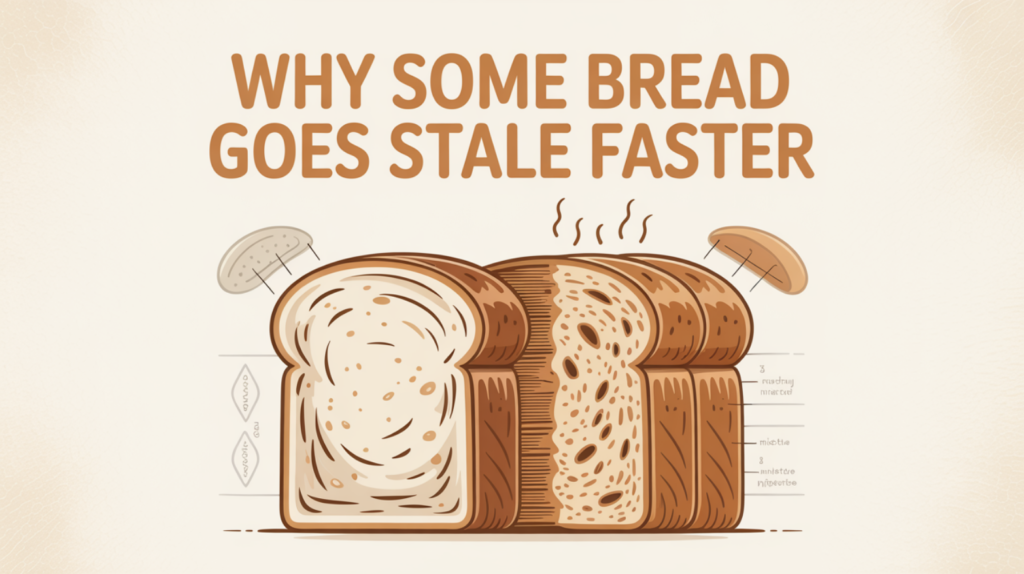
Staling is not the same as mould. Bread can feel dry, tough, or “old” while still being perfectly safe to eat. What changes is the eating experience, softness, chew, and that fresh-bread aroma.
If you’ve already set up a better routine from our bread storage guide, understanding staling helps you choose loaves that match your household pace.
Stale happens because bread changes inside, not because it “dries out” only
Bread does lose moisture over time, but staling is also about the crumb firming up. The loaf’s structure shifts after baking, which is why bread can feel stale even when it isn’t visibly dry.
That’s also why toast fixes so many “stale bread” problems, heat softens the crumb and brings back aroma.
The main reasons some loaves go stale quicker
1) A crusty loaf loses freshness faster once cut
Rustic and artisan-style breads often feel amazing on day one, but once the loaf is sliced, the crumb is exposed and changes faster.
That’s part of the deal with artisan loaves described in this UK artisan bread explanation: you’re buying flavour and crust, but you’re also buying a shorter “perfect window”.
What to do: slice only what you need, or freeze slices early.
2) Lean breads stale faster than soft sliced loaves
Many soft supermarket loaves stay pleasant longer because their recipes are designed for it. They often retain moisture well and keep the crumb softer day-to-day.
That’s why everyday white sliced bread can stay usable longer than a bakery-style loaf, even if the bakery loaf tastes better fresh.
3) Wholegrain and grain-heavy loaves can feel “stale” sooner
Wholemeal, multigrain, and seeded breads often have a firmer bite from the start. When they lose a little softness, they can feel stale earlier than a very soft loaf even if they’re still fine.
If you rotate those loaves at home, it helps to treat multigrain as a “toast + freezer” bread more often, especially the heavier styles discussed in UK multigrain bread picks.
4) Slice thickness changes everything
Thin slices lose their best texture quickly. Thick slices hold onto a nicer crumb for longer and are easier to revive with toast.
This is one reason sandwich breads can be a bit hit-or-miss: they’re convenient, but their thin slices don’t forgive slow eating.
5) Heat and airflow speed the change
Bread stored near a kettle, microwave, oven, or a sunny window tends to stale faster. Warm air and repeated temperature changes aren’t friendly to bread.
Quiet fix: move bread to a cool cupboard away from appliances.
6) “Brown” bread varies a lot, so staling varies too
Some brown breads are closer to white bread in softness. Others are closer to wholemeal in firmness. That’s why one brown loaf stays soft for days while another feels dry the next day.
If you buy brown bread often, UK brown bread options are worth comparing by texture, not just colour.
7) Sourdough behaves differently
Sourdough can feel chewy for longer than many loaves, but it still changes after a couple of days. The advantage is that it usually revives brilliantly with heat, which is why it’s one of the easiest breads to slice and freeze.
That’s also why people who love toast often settle into a good UK sourdough as their “freezer loaf”.
What to buy if your household eats bread slowly
If bread lasts a week in your kitchen, you’ll be happier with loaves that:
- slice cleanly
- toast well
- freeze without turning unpleasant
A practical setup is:
- one soft loaf in the cupboard for quick lunches
- one flavour loaf sliced in the freezer for toast and dinners
How to rescue bread before you give up on it
| Bread problem | What usually works |
|---|---|
| Feels dry but not mouldy | Toast it |
| Crusty loaf has gone hard | Warm it briefly in the oven |
| Grain loaf feels “tired” | Toast + butter brings it back |
| Slices are brittle | Turn into breadcrumbs or croutons |
The simplest way to stop staling from winning
Most staling complaints disappear if you do one thing early:
Freeze part of the loaf on day one.
It sounds small, but it changes everything, because you’re matching bread’s best texture window to how your home actually eats.