
GroceriesReview.co.uk provides independent reviews and recommendations. Some pages contain affiliate links to Amazon.co.uk, and we may earn a commission when you make a qualifying purchase at no extra cost to you.
Firmness is not one single thing in pasta. It is the result of what the pasta is made from, how it was processed, which shape it takes, and how long it spends in the pan. So when one pack feels pleasantly firm and another turns soft quickly, the difference usually began well before it reached a UK supermarket shelf.
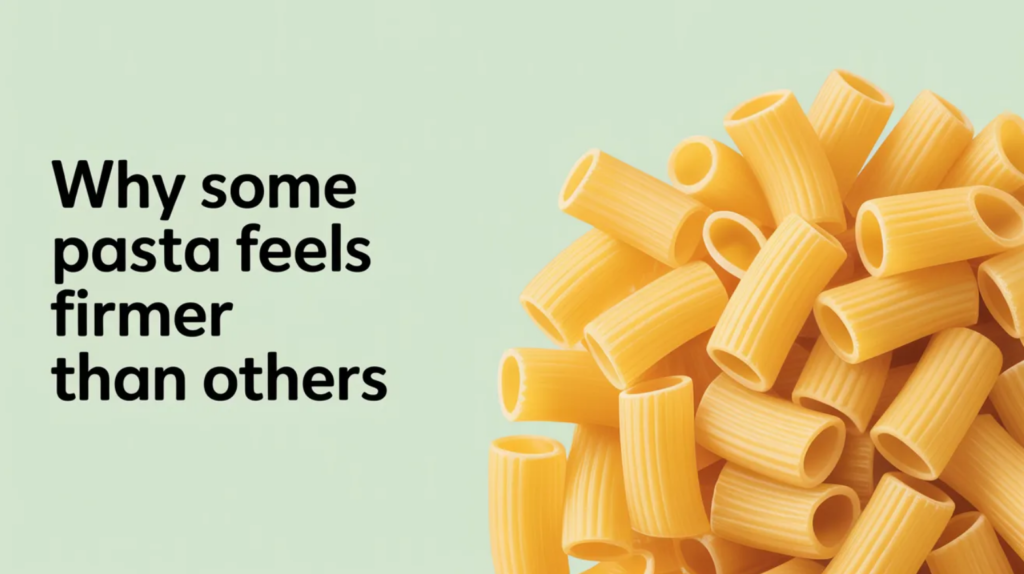
The short version is this: pasta tends to feel firmer when it is made from strong durum wheat semolina, processed well, dried carefully, and cooked only to the point where it is tender outside but still resistant at the centre. Once any of those variables change, the texture can change with them.
It often starts with the wheat
Good-quality conventional dried pasta is typically associated with durum wheat semolina. Reviews of pasta quality note that semolina with high protein and strong gluten is the ideal raw material for conventional dry pasta, because that gluten network helps the pasta withstand extrusion, drying, and cooking. In practical terms, that stronger structure is one reason some pasta keeps a firmer bite for longer than cheaper or weaker-feeling alternatives.
That also helps explain why two plain dried pastas can feel different even when both are labelled simply as spaghetti or penne. The ingredient list may look similar, but the quality of the semolina and the strength of the gluten network still affect the final texture. Barilla, for example, describes its target texture as tender outside and firm at the core, which is really a texture goal built into the product from the start rather than something created only at the hob.
The factory can make a real difference
Pasta firmness is not decided by ingredients alone. A major review of pasta-making describes drying as one of the core processing steps affecting final quality, and the EPA’s pasta manufacturing guidance goes further, calling drying the most difficult and critical step to control. Its purpose is to reduce moisture to roughly 12 to 13 percent so the finished pasta will be hard, hold its shape, and store well.
Drying has to be balanced. If pasta dries too quickly, the outside can harden faster than the inside, which creates stress in the structure and can lead to cracking and weak mechanical strength. De Cecco’s description of slow drying makes the same basic point from a manufacturer’s angle, presenting drying time and temperature as quality factors rather than just factory efficiency. This is one reason premium dried pasta can sometimes feel more resilient and controlled in texture after cooking.
Shape changes how firmness is perceived
A thick tube of rigatoni and a fine strand of spaghetti are not going to feel equally firm, even if they come from the same brand. The pasta-making literature treats the shape of the extruded product as one of the variables that affects quality, and from a shopper’s point of view that translates into a simple kitchen reality: thicker or denser shapes usually keep more resistance in the centre, while finer shapes soften through more quickly. That is partly a production point and partly a cooking inference from the way different shapes take up water.
So when shoppers say one pasta “has more bite”, they are not always comparing better pasta with worse pasta. Sometimes they are just comparing a shape that naturally stays firmer with one that softens faster. On UK shelves, that difference often shows up between long thin strands, broader ribbons, short tubes, and very small shapes such as orzo.
Wholewheat and white pasta do not usually soften in the same way
Wholewheat pasta often feels firmer than standard white pasta, and there is research behind that impression. One comparative study found that whole-grain pasta showed greater hardness and lower water absorption than white-flour pasta after cooking, linking that difference to the way bran affects the gluten-starch structure. So the firmer feel many shoppers notice is not just in their head. It is a real texture difference tied to the flour and structure of the pasta itself.
In supermarket terms, that is why wholewheat pasta often feels a little denser and a little less smooth than the white version beside it, even when the shape is identical. The pasta has not merely been coloured differently. Its structure behaves differently in water.
Gluten-free pasta is a separate texture story
Gluten-free pasta often feels different because it is built differently. A review of gluten-free pasta explains that these products are commonly made from corn, rice, potato, or other non-wheat starches and flours, often with added proteins, gums, or emulsifiers to partially substitute for gluten. The same review is explicit that no single ingredient fully replaces gluten, which is why texture varies so much across the category.
That is the reason one gluten-free pasta can stay reasonably firm while another becomes soft or fragile more quickly. Manufacturers often use proteins, hydrocolloids, enzymes, or extrusion-cooking methods specifically to improve firmness, elasticity, and cooking quality. For UK shoppers in the free-from aisle, the practical lesson is that gluten-free pasta is not one uniform texture category at all.
Most of the final difference still happens in the pan
Even well-made pasta can lose its firmness if it is cooked too long. Barilla’s cooking guidance says the pack time is designed for cooking pasta al dente, and the company describes the ideal result as firm at the core. In other words, the texture many shoppers want is partly built into the product and partly protected by stopping the cooking at the right moment.
This is why two people can buy the same pasta and describe it differently. One may boil it until fully soft, while the other drains it as soon as it still has a little resistance left. The pasta has not changed, but the eating experience has.
What shoppers in the UK are really noticing
On a supermarket shelf, firmness is often being signalled indirectly. Durum wheat semolina, wholewheat, gluten-free blends, premium drying claims, and different shapes all point towards different cooking results. Some packs are built for a clean, firm bite. Others are built for speed, softness, convenience, or dietary needs.
So if some pasta feels firmer than others, the answer is rarely just price or brand. It is usually a mix of wheat quality, gluten strength, drying method, shape, ingredient type, and cooking time. Once you look at firmness that way, the difference between pasta packs on UK supermarket shelves becomes much easier to understand.