
GroceriesReview.co.uk provides independent reviews and recommendations. Some pages contain affiliate links to Amazon.co.uk, and we may earn a commission when you make a qualifying purchase at no extra cost to you.
Crispness is one of the first things shoppers notice when opening a jar of gherkins. Some have a clean snap and hold their shape well in burgers, sandwiches and salads. Others feel softer, wetter and less distinct. That difference usually comes down to how the gherkins were grown, processed, packed and stored before they ever reached the shelf.
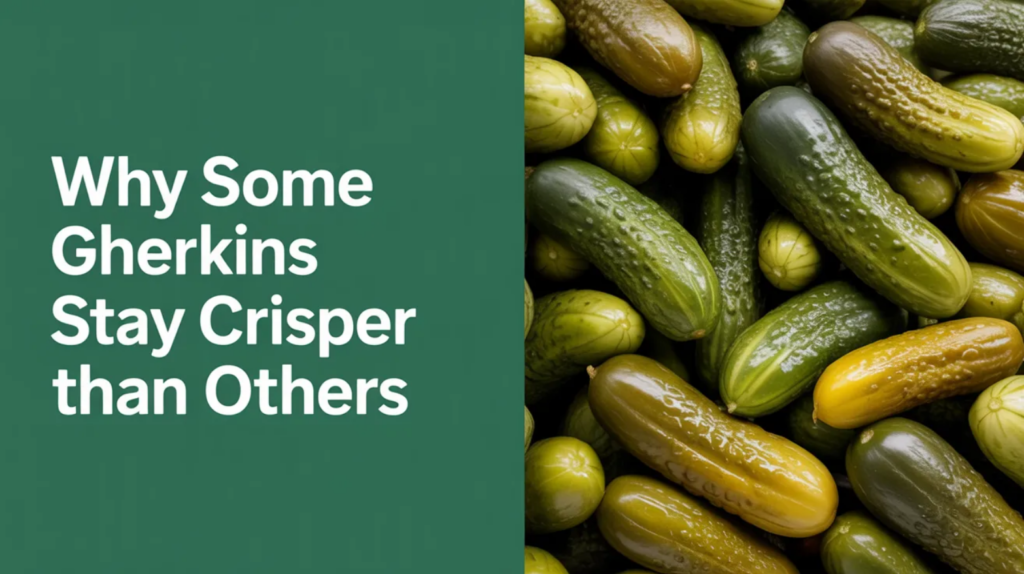
A crisper gherkin is not just a matter of luck. Texture is shaped at several stages, from the size of the cucumber to the cut, the brine, and how long the jar has been open.
Smaller cucumbers usually give a firmer result
Gherkins made from younger, smaller cucumbers often stay crisper because the flesh is denser and the seed content is lower. Once cucumbers grow larger, the inside tends to become softer and more watery. That makes it harder for the final pickle to keep a tight bite.
This is one reason mini gherkins and smaller whole pickles often feel firmer than larger sliced versions. The starting vegetable simply has a better texture base.
Salt and brining help keep the structure intact
Before sale, many gherkins go through a salting or brining stage. This helps draw out some water and strengthens the texture. Without that step, the cucumber can soften too easily once it sits in pickling liquid.
For shoppers, that process is invisible, but it affects the jar noticeably. A well-brined gherkin tends to feel springy and resilient rather than limp.
The recipe matters, not just the cucumber
Two jars can both contain pickled cucumbers and still behave very differently. The balance of vinegar, salt, sugar and seasoning changes how firm the gherkins remain over time.
A sweeter pickle can sometimes feel slightly softer because the overall style is built around a gentler eating experience. A sharper, more straightforward pickle often keeps a firmer bite. That is not a strict rule in every jar, but it is a pattern shoppers often notice across supermarket ranges.
Whole gherkins usually keep their crunch better than sliced ones
Once a gherkin is sliced, more of its interior is exposed to the liquid. That is useful for convenience, but it can mean a softer texture over time, especially after opening.
Whole gherkins generally protect their structure better. They are also more flexible in use, since they can be sliced at home when needed. For anyone who cares strongly about crunch, whole jars often have the edge over pre-sliced ones.
Heat treatment can affect bite
Commercial pickles are often heat-processed so they remain shelf-stable in sealed jars. That is important for safety and storage, but heat can also soften vegetables if the balance is not handled well.
A better-made jar manages both preservation and texture. A softer jar may still be perfectly acceptable, but the gherkins will feel less lively on the plate. This is one reason premium or more carefully produced jars can sometimes stand out on texture rather than just flavour.
Time in the liquid changes the texture
Even a good gherkin does not stay frozen in time. The longer it sits in the jar, the more the liquid continues to work on it. Over time, that can reduce firmness, especially once the jar has been opened and used repeatedly.
This is why a newly opened jar often seems crisper than the same jar a few weeks later. Keeping the gherkins submerged and using a clean utensil helps, but some gradual softening is normal.
Storage at home plays a part too
After opening, gherkins are usually kept in the fridge, and that helps preserve their texture. If they are left warm for too long, handled carelessly, or not kept covered by the pickling liquid, the quality can drop faster.
A jar that starts crisp can lose some of that advantage if it is poorly stored. So the crunch is partly about manufacturing, but partly about what happens in the kitchen afterwards.
What shoppers can look for
When buying gherkins in the UK, a few clues can suggest a firmer jar:
- whole rather than sliced
- smaller gherkins rather than very large ones
- a clear, tidy-looking jar with intact pieces
- recipes that seem more pickle-led than overly sweet or sauce-heavy
It is also worth remembering that some jars are made mainly for burger convenience, while others are closer to deli-style pickles where crunch is a bigger selling point.
Conclusion
Some gherkins stay crisper than others because of the cucumber size, the brining process, the recipe, the cut, the heat treatment and the way the jar is stored after opening. Crispness is built step by step rather than added at the end.
For UK shoppers, the firmest bite usually comes from smaller whole gherkins in a well-balanced pickle, especially when the jar is stored properly once opened.