
GroceriesReview.co.uk provides independent reviews and recommendations. Some pages contain affiliate links to Amazon.co.uk, and we may earn a commission when you make a qualifying purchase at no extra cost to you.
Kidney beans and black beans often sit close together on UK supermarket shelves, yet they give quite different results in a dish. They are both commonly sold cooked in tins, both belong in the wider beans and pulses category, and both work well in hearty meals, but they differ in colour, size, texture, and the way they usually come across on the plate.
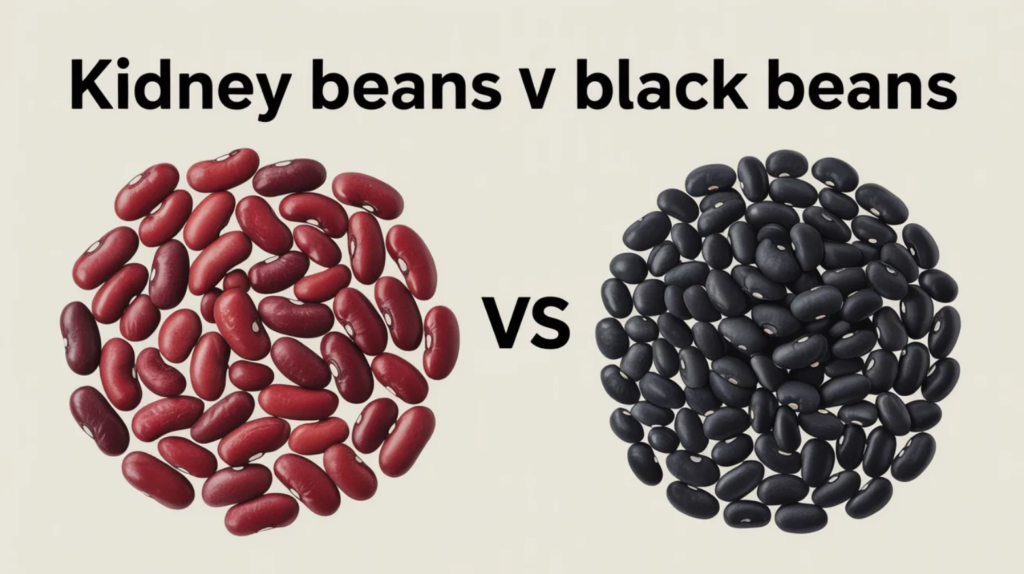
A simple way to separate them is this: kidney beans are larger, softer, and more obviously shaped, while black beans are smaller, darker, and often feel slightly denser.
They may be sold in similar formats, but they do not feel the same
In most UK supermarkets, both beans are easiest to find in tins. Kidney beans are one of the standard lines in almost every supermarket, from small convenience branches to larger stores with wider world food sections. Black beans are now much more common than they used to be, although they can still be less consistently stocked in smaller shops.
Even when the format is the same, the eating experience is not. A tin of kidney beans usually gives you larger beans with a softer centre and a more familiar supermarket-storecupboard feel. Black beans tend to look neater and more compact, and they often keep a slightly firmer skin after heating.
Appearance tells you quite a lot
Kidney beans are named for their curved, kidney-like shape. They are usually deep red or reddish brown on UK packaging and are easy to spot in chilli mixes, stews, and mixed bean salads because of their size.
Black beans are smaller, rounder, and much darker. Once cooked, they still hold a glossy black outer skin, which makes them stand out differently in a bowl or on a plate. They do not dominate visually in the same way kidney beans do, but they give dishes a darker, denser look.
This visual difference is more important than it first seems. In bean salads, rice dishes, and wraps, the type of bean changes not only flavour and texture but also the overall appearance of the meal.
The texture is where many shoppers notice the real difference
Kidney beans are usually softer and more floury inside, especially in tinned form. They absorb surrounding flavours well and sit comfortably in thick sauces. In a chilli or tomato-based stew, they tend to become part of the overall texture rather than standing apart from it too sharply.
Black beans usually feel smoother and slightly firmer. They still soften when cooked, but they often keep more definition. That makes them useful in dishes where the beans need to hold their shape without turning too soft or blending into the sauce too much.
Neither texture is better in general. It depends on whether the meal needs a softer, more traditional bean feel or something a little tighter and more compact.
Flavour differences are present, even if neither is strong
Neither bean is strongly flavoured in the way olives or capers are, but there is still a difference.
Kidney beans are mild and fairly neutral, with a soft, earthy taste that works easily in rich sauces and long-cooked meals. Their main role is often to add bulk and body.
Black beans have a deeper earthiness and can seem a little richer, especially when paired with spices, rice, onions, and smoky flavours. They still take on surrounding seasoning well, but they bring slightly more character of their own.
That is one reason the two beans are often associated with different styles of meal, even though they are both versatile.
They tend to appear in different kinds of dishes
In Britain, kidney beans are strongly linked with chilli con carne, mixed bean dishes, jacket potato toppings, and tomato-heavy stews. They are one of the most familiar tinned beans after baked beans and chickpeas, so many shoppers buy them almost automatically for everyday cupboard cooking.
Black beans are more often chosen for burrito fillings, soups, rice bowls, tacos, and Latin American-style dishes. They also work well mashed into patties or folded into a thicker bean mixture because their texture stays relatively cohesive.
You can swap one for the other in some recipes, but the result will not be identical. A chilli made with black beans instead of kidney beans usually feels a bit firmer and darker. A rice bowl made with kidney beans instead of black beans often feels softer and slightly less tidy in texture.
UK supermarket range also shapes what people buy
Kidney beans are usually easier to find across all supermarket sizes. Own-label tins are standard in Tesco, Sainsbury’s, Asda, Morrisons, Aldi, Lidl, Waitrose, and Ocado, and they are often sold in multipacks as well as single tins.
Black beans are now mainstream in larger UK supermarkets, but the range can still vary more by store size and location. In some smaller branches, there may be only one black bean line, whereas kidney beans will nearly always be present in at least one standard own-label format.
That availability affects cooking habits. Many shoppers use kidney beans more often simply because they are a routine cupboard purchase, while black beans are still more likely to be bought for a planned meal.
Labels and liquid in the tin can make a difference too
When comparing the two in UK supermarkets, it is worth looking beyond the bean name. Some tins contain beans in plain water, while others include brine. Salt level, firmness, and bean size can vary slightly by brand and own-label tier.
You may also notice that black beans sometimes look more compactly packed, while kidney beans often seem larger and more spaced out in the tin. That is not just visual. It affects drained weight, how the beans rinse, and how prominent they feel once added to a dish.
For shoppers who care about texture, these pack differences can matter almost as much as the bean type itself.
Which one is better for everyday use?
Kidney beans are usually the more familiar all-round choice in British cupboard cooking. They suit classic supermarket meals, especially chillies, casseroles, and quick bean-based sauces. Their softness makes them easy to work into hearty dishes without much planning.
Black beans are especially useful when you want a firmer bean that keeps more shape and brings a slightly deeper flavour. They are often the better fit for rice dishes, wraps, and meals where the beans are meant to stay distinct.
So the better choice depends less on nutrition claims or trend value and more on the kind of meal you are making.
Conclusion
Kidney beans and black beans are close enough to sit side by side on supermarket shelves, but they are not the same in use. Kidney beans are larger, softer, and more associated with classic UK cupboard meals such as chilli and bean stews. Black beans are smaller, firmer, and often better suited to rice dishes, wraps, and meals where texture needs to stay more defined.
For shoppers in the UK, the clearest distinction is practical: kidney beans melt into a dish more easily, while black beans keep a bit more structure. Once you notice that difference, choosing between them becomes much more straightforward.