
GroceriesReview.co.uk provides independent reviews and recommendations. Some pages contain affiliate links to Amazon.co.uk, and we may earn a commission when you make a qualifying purchase at no extra cost to you.
Salt looks simple on a supermarket shelf, but it reaches your kitchen through three main routes: salt taken from seawater, salt mined from underground rock, and salt made by evaporating purified brine. Those routes shape the grain size, dryness, and the words you see on packaging.
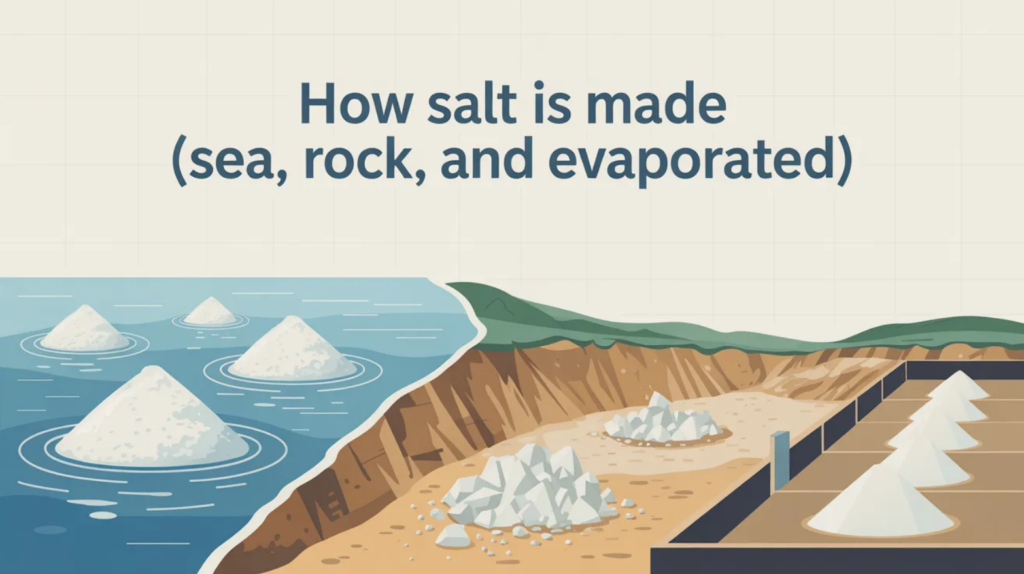
This guide explains how each type is produced, what it tends to look like, and how to recognise it when you’re shopping in the UK.
The three routes, in one picture
- Sea salt
Seawater → filtered → evaporated → crystals/flakes collected - Rock salt
Underground deposits → mined → crushed/washed → graded crystals (sometimes refined further) - Evaporated salt
Water + underground salt deposit → brine made → cleaned/purified → vacuum evaporation → fine, very consistent salt
Route 1: Sea salt (from seawater)
Step-by-step
1. Seawater is collected
Salt producers draw seawater from coastal areas. It’s typically screened to remove larger particles.
2. The water is evaporated
Evaporation can happen by sun and wind (traditional salt pans) or with controlled heating in modern facilities. As the water leaves, salt begins to form.
3. Crystals form and are harvested
The salt is collected, drained, and dried to different levels depending on the style.
Why sea salt comes in so many textures
The same seawater method can create very different results:
- Fine sea salt (more dried and milled)
- Crystals (chunkier grains that suit grinders)
- Flakes (thin, fragile plates designed for finishing)
If you’re building your product pages around formats, your roundup page is a natural companion: Best Sea Salt in the UK.
What UK packs often say
Look for phrases like:
- “Sea salt”
- “Sea salt crystals”
- “Sea salt flakes”
- “Harvested” or a coastal origin (varies by brand)
If the pack highlights a UK origin, Cornish sea salt is a common example of sea salt marketed for finishing and everyday cooking depending on grain size: Best Cornish Sea Salt in the UK.
Route 2: Rock salt (mined salt)
Step-by-step
1. Salt deposits are mined
Rock salt comes from ancient sea beds that became salt layers underground. The salt is extracted by mining.
2. It’s crushed and graded
After mining, rock salt is broken into different grain sizes. Some is left coarse; some is milled finer.
3. It may be washed or refined
Food-grade rock salt is usually cleaned to remove impurities. Highly refined versions are often sold as standard table salt.
Why rock salt is often used for grinders
Rock salt tends to be naturally well-suited to:
- Coarse crystals for mills
- Refill bags for grinders
- Cooking where slow dissolving is fine (roasts, pasta water)
What UK packs often say
Common terms include:
- “Rock salt”
- “Coarse rock salt”
- “Salt crystals”
- “Suitable for grinders”
If your reader’s main question is “Which one seasons more predictably?”, your comparison piece can sit as the next click: Sea Salt vs Table Salt (What’s the Real Difference?).
Route 3: Evaporated salt (vacuum-pan / refined salt)
Evaporated salt is the “engineered consistency” option. It’s made to be dry, uniform, and easy to measure.
Step-by-step
1. Brine is created and purified
Instead of evaporating seawater directly, producers start with brine that can be cleaned more thoroughly.
2. The brine is evaporated under vacuum
In vacuum evaporation, water boils at lower temperatures, making production efficient and controlled.
3. Fine salt is formed and dried
The result is typically a very consistent grain, often the foundation for common table salt products.
Why it’s popular for baking and everyday cooking
Evaporated salt is usually:
- Very fine
- Very dry
- Consistent from one pack to the next
That’s why many shoppers keep it as their everyday “measuring salt”, which pairs neatly with a finishing salt if they enjoy texture. Your buyer-focused shortlist fits here: Best Table Salt in the UK.
What UK packs often say
Look for:
- “Table salt”
- “Free-flowing”
- “Fine”
- “Iodised” (only if iodine is added)
A supermarket-facing comparison (what changes for the shopper)
| Route | Typical look | Common use in a UK kitchen | What the label often emphasises |
|---|---|---|---|
| Sea salt | Fine grains, crystals, or flakes | Finishing and general cooking (depending on grain) | “Flakes”, “crystals”, origin |
| Rock salt | Usually crystals/coarse grains | Grinders, roasting, robust cooking | “Rock”, “crystals”, “coarse” |
| Evaporated salt | Fine, very uniform grains | Baking, sauces, everyday measuring | “Table”, “fine”, “free-flowing” |
Where pink salt and Celtic-style salts fit into this
These are still salt routes with a “type” label added on top.
Pink salt
Most pink salt is a form of rock salt (mined), sold as fine grains or crystals. If you want to connect this to your shopping content without repeating links, your dedicated page is the clean hand-off: Best Pink Salt in the UK.
Celtic salt (often sold as “grey salt”)
Celtic-style salts are generally sea salts known for their slightly moist, mineral-rich style and a softer texture in the jar. If you’re covering it as a distinct product category, this page is the natural destination: Best Celtic Salt in the UK.
How to read “made” claims without overthinking
When packs say things like “hand-harvested” or highlight a region, treat it as a clue about:
- texture (flakes vs fine)
- intended use (finishing vs cooking)
- brand positioning (premium vs everyday)
For most home cooking, the practical wins come from choosing the right grain size, not from chasing a dramatic origin story.
The simple takeaway
Sea salt is produced by evaporating seawater and can be fine, crystal, or flaky. Rock salt is mined and usually appears as crystals or coarse grains, often for grinders. Evaporated salt is made from purified brine under controlled conditions and typically becomes the fine, consistent table salt many people use for everyday cooking and baking.