
GroceriesReview.co.uk provides independent reviews and recommendations. Some pages contain affiliate links to Amazon.co.uk, and we may earn a commission when you make a qualifying purchase at no extra cost to you.
Beans and pulses may look like simple supermarket staples, but they go through several processing stages before they reach UK shelves. The exact process depends on whether the product is being sold dried, tinned, jarred, or in a ready-to-use pouch. A bag of red lentils has been handled very differently from a tin of butter beans, even though both belong to the same broad grocery category.
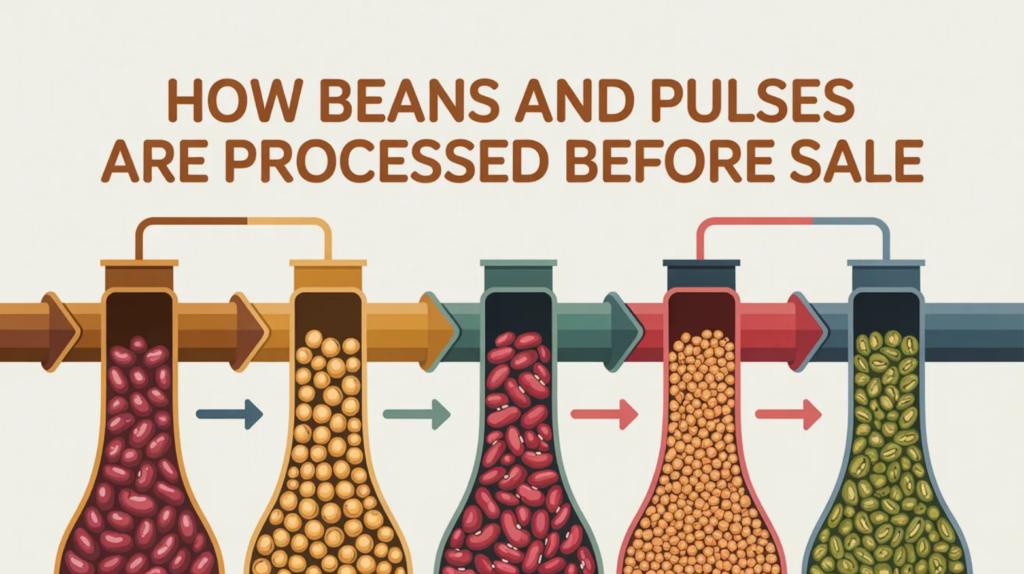
For shoppers in Britain, the most useful way to understand processing is to follow the product from harvest to shelf. Once you do that, the differences between dried and ready-cooked beans make much more sense.
Processing starts with cleaning and sorting
Before beans and pulses are packed for sale, they are cleaned. After harvesting, the raw crop can contain dust, small stones, bits of plant material, and uneven grains or beans. That means the first processing stage is usually about removing anything that should not end up in the pack.
This is also when the beans or pulses are sorted by size, colour, and condition. Broken pieces, damaged beans, and discoloured grains may be separated out, especially in products meant to look neat and uniform on supermarket shelves. In UK retail ranges, this step matters because shoppers expect a pack of lentils or a tin of beans to look consistent once opened.
Dried beans and pulses are processed for storage
If the product is being sold dry, the aim is to make it shelf-stable while keeping it suitable for cooking later at home. After cleaning and sorting, the beans or pulses are dried to a safe moisture level so they can be stored for long periods without spoiling.
That is why dried pulses in UK supermarkets are mainly sold in sealed plastic bags, paper-style packs, or other cupboard-friendly packaging. They are not ready to eat at that stage. They have simply been cleaned, stabilised, and packed in a form that allows long storage.
Some products then go through one more step before packing. Red lentils, for example, are often split and may also be polished so they cook more quickly and look more even in the pack. This is one reason dried pulses on supermarket shelves can differ so much in appearance even before you start cooking them.
Some pulses are split, skinned, or polished
Not every pulse is sold whole. Part of the processing can involve removing the outer skin, splitting the pulse in half, or polishing the surface. This is particularly relevant with lentils, peas, and some world foods products sold in UK supermarkets.
The reason is practical rather than cosmetic alone. A split pulse usually cooks faster and breaks down more readily. A whole pulse holds its shape better. So the level of processing affects how the product behaves in the kitchen, not just how it looks in the pack.
This is where shoppers often notice a difference between, say, whole green lentils and split red lentils. They may both be lentils, but the processing changes their cooking role quite a lot.
Tinned beans go through much heavier processing
Tinned beans and pulses follow a longer route before sale because they are sold cooked and preserved rather than raw and dry. Once cleaned and sorted, they are usually soaked and then cooked before being packed into tins or jars.
That stage is what gives tinned beans their convenience. A shopper buying kidney beans, chickpeas, or cannellini beans in a tin is buying a product that has already been hydrated and softened. The supermarket format reflects that. Tinned pulses are there for speed, not for scratch preparation.
After cooking, the beans are packed with liquid, often water or light brine, then sealed and heat-treated so they stay shelf-stable. This final stage is a major part of why tinned beans last so long in the cupboard.
Soaking is part of processing for many ready-cooked beans
With tinned products, soaking often happens before cooking. Larger beans in particular benefit from this because it helps them absorb water more evenly and cook more consistently.
For UK shoppers, that processing step is mostly invisible, but it explains why tinned beans are softer and quicker to use than dried ones. The time-consuming stages have already happened before the product reaches the supermarket.
This also helps explain why some beans are far more commonly bought in tins than in dried form. The processing removes a lot of the effort that would otherwise be needed at home.
Cooking, packing liquid, and heat treatment all affect the final product
Once beans are cooked for sale, the processor still has to decide how they will be packed. Some go into plain water, some into lightly salted liquid, and some into sauce. In UK supermarkets, most plain pulses are sold in water or brine so they can be used flexibly in different meals.
The heat treatment after sealing is what makes the product safe and shelf-stable. It also affects texture. A bean that has been fully cooked and preserved in a tin will usually feel softer than one cooked from dry at home to a more exact point.
That is why processing is not just about safety or storage. It also shapes what the shopper gets once the pack is opened.
Pouches sit somewhere between dried and tinned formats
Ready-to-use pouches have become more common in UK supermarkets, especially for lentils, mixed beans, and seasoned pulse products. These are also processed before sale, but the format is slightly different from a standard tin.
The pulses are usually cooked before packing, then sealed in a pouch designed for convenience. Sometimes they are sold plain, and sometimes they are seasoned or mixed with grains. The purpose is similar to tinned pulses, but the packaging is lighter and often aimed at quicker meal assembly.
For shoppers, the main point is that pouch-packed pulses have already gone through the labour-heavy part of processing. They are sold for ease rather than for long preparation.
Processing also includes grading for supermarket quality
Beyond cleaning and cooking, processors also grade products to meet the standards expected by retailers. That can include size consistency, colour, the number of split beans allowed in a pack, and how intact the product looks.
This matters because supermarket own-label and premium lines are not always packed to the same visual standard. One pack may contain more uniform beans, while another may be slightly more mixed in size or appearance. The beans may still be perfectly usable, but the processing standard can affect how tidy the product looks on the shelf and on the plate.
The type of sale format tells you how much processing has already happened
A useful rule for UK shoppers is that the more convenient the format, the more processing has usually taken place before sale.
A dried bag of lentils has mainly been cleaned, sorted, dried, and packed. A split pulse has been further processed for faster cooking. A tin of beans has been soaked, cooked, packed in liquid, sealed, and preserved. A ready pouch has usually been cooked and packed for direct use.
That is why different products within the beans and pulses aisle can behave so differently, even when they come from the same broad ingredient family.
Why this matters when shopping
Understanding processing helps with buying decisions. A shopper who wants maximum convenience will usually choose a format that has already been soaked and cooked. Someone who wants more control over texture may prefer dried pulses. Someone choosing between whole and split lentils is really choosing between different levels of processing and different cooking outcomes.
In UK supermarkets, those distinctions are easy to miss because the products are often grouped closely together. But the packaging, format, and appearance usually reveal a lot about what has already happened before the item reached the shelf.
Conclusion
Beans and pulses are processed before sale in ways that depend heavily on how they are going to be sold. Dried products are cleaned, sorted, dried, and sometimes split or polished. Tinned and pouch-packed products go much further, usually through soaking, cooking, packing, and heat treatment so they are ready to use and stable in the cupboard.
For UK shoppers, that processing explains why one pulse may need soaking at home while another can be tipped straight into the pan. Once you see the aisle in those terms, the different formats become much easier to understand.