
GroceriesReview.co.uk provides independent reviews and recommendations. Some pages contain affiliate links to Amazon.co.uk, and we may earn a commission when you make a qualifying purchase at no extra cost to you.
Red lentils and green lentils are sold in the same broad pulse category in UK supermarkets, but they behave so differently in cooking that they are best treated as separate cupboard staples rather than close substitutes. The main difference is not just colour. It is what happens once they hit the pan.
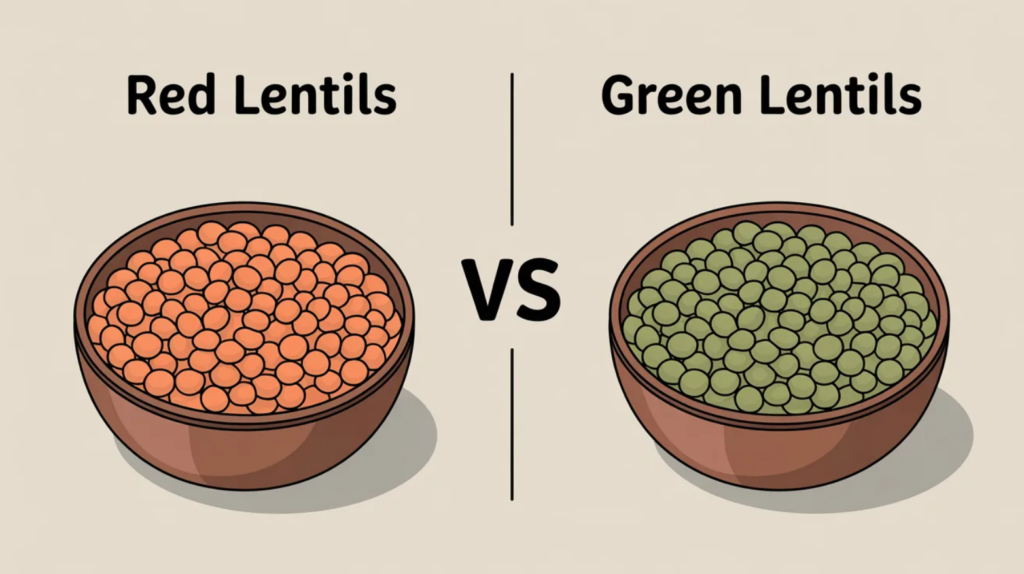
Red lentils soften quickly and often break down into the dish. Green lentils hold their shape much better and stay more distinct after cooking. For shoppers in Britain, that is usually the most useful distinction to understand before buying either one.
They look different before cooking, but the bigger difference comes later
On the shelf, red lentils are usually smaller, flatter, and more brightly coloured, often sold split and dried in plastic bags. Green lentils are darker, duller in colour, and usually sold whole. That visible difference matters, but not as much as the way each type responds to water and heat.
A bag of red lentils is normally bought with the expectation that the lentils will soften into soups, dhal, or thick sauces. By contrast, green lentils are more often chosen when the pulse needs to stay intact in salads, side dishes, or stews.
Red lentils cook for softness
Red lentils are one of the most practical pulses in the UK cupboard aisle because they cook quickly and do not usually need soaking. Once simmered, they begin to lose their shape and create a softer, thicker texture in the pan.
That is why they are so commonly used in soups, curries, dhal, and blended savoury dishes. They are not usually chosen for visual neatness. They are chosen because they help build body and texture without requiring long cooking or much preparation.
In supermarket terms, red lentils suit shoppers who want a pulse that feels easy, fast, and dependable in warming everyday meals.
Green lentils cook for structure
Green lentils move in the opposite direction. They generally need a little more cooking time and they keep more bite once cooked properly. Instead of melting into the background, they remain separate and visible.
This gives them a different role on the plate. Green lentils are often better in warm salads, lentil side dishes, traybakes, and recipes where the pulse should still look like an ingredient in its own right rather than a thickener.
That difference becomes especially obvious when the lentils are tossed with vegetables, dressings, or grains. Red lentils would usually collapse in that setting, while green lentils can stay presentable and more textured.
Texture is the real dividing line
If a shopper is deciding between the two in a UK supermarket, texture is usually the deciding factor.
Red lentils produce a softer finish, sometimes almost creamy once fully cooked. They suit dishes where the lentils are meant to blend into the liquid or form part of the overall consistency.
Green lentils feel firmer, more separate, and slightly more robust. They do not usually create the same thickening effect unless cooked for much longer than normal. In practice, one is chosen to disappear into the dish, while the other is chosen to remain visible.
That makes them useful in different ways, even when the seasoning is similar.
Their flavour is not identical either
Both lentils are fairly mild, but the flavour profile is not exactly the same. Red lentils tend to feel gentler and less pronounced once cooked down. Because they soften so much, they take on surrounding flavours very easily and rarely dominate the dish.
Green lentils usually bring a more earthy, savoury note and a slightly stronger pulse character. The flavour is still subtle, but it stands out more because the lentils keep their shape and texture.
This is one reason green lentils often work well in simpler dishes where the lentil itself is meant to be noticed, while red lentils are often used in meals where the lentil is supporting the texture more than the flavour.
UK supermarkets usually sell them with different expectations
The way they are sold in Britain reflects this difference in use. Red lentils are often one of the most visible dried pulses in mainstream supermarket ranges because they suit quick soups, easy curries, and budget-friendly meal planning. They are a standard cupboard ingredient in many households.
Green lentils are also easy to find in larger supermarkets, but they can feel slightly more purpose-led. Shoppers are more likely to buy them for a particular dish rather than just as a general pantry fallback. Some stores also stock ready-cooked green lentils in pouches, which reinforces their use in salads and quick assembled meals.
So although both are staple pulses, red lentils often feel more universal in everyday British cooking, while green lentils feel a little more specific in function.
They are not always a straight swap
It is technically possible to swap one for the other in some recipes, but the result usually changes quite a lot.
Using green lentils where a recipe expects red lentils will normally produce a firmer, looser dish with less thickening. Using red lentils where green lentils are meant to stay whole will often lead to a softer, less defined texture.
That is why the choice between them is not a minor detail. It affects how the meal holds together and what the final bowl or plate actually feels like to eat.
Which one makes more sense for everyday cupboard use?
For many UK shoppers, red lentils are the easier all-purpose pulse to keep on hand because they are quick, simple, and useful in a wide range of low-effort meals. They fit soups, stews, dhal, and budget cooking without needing much planning.
Green lentils make more sense when texture matters and when the dish needs the lentils to stay distinct. They are especially useful for structured meals rather than soft, spoonable ones.
So the better choice depends less on which lentil is supposedly superior and more on whether you want softness or shape.
Conclusion
Red lentils and green lentils may share shelf space in UK supermarkets, but they are suited to different jobs in the kitchen. Red lentils cook down quickly and help create a softer, thicker dish. Green lentils stay firmer and work better when the pulse needs to hold its shape.
For shoppers in Britain, the easiest way to choose is to think about the finished texture first. If the lentils are meant to melt into the meal, red lentils are usually the right fit. If they need to stay separate and structured, green lentils are the better choice.