
GroceriesReview.co.uk provides independent reviews and recommendations. Some pages contain affiliate links to Amazon.co.uk, and we may earn a commission when you make a qualifying purchase at no extra cost to you.
Chickpeas and lentils are both staple pulses in UK supermarkets, but they are not interchangeable in every situation. They differ in size, texture, cooking behaviour, flavour, and the way they are usually sold. That matters because shoppers often see them grouped in the same cupboard aisle, yet they behave very differently once they go into a pan.
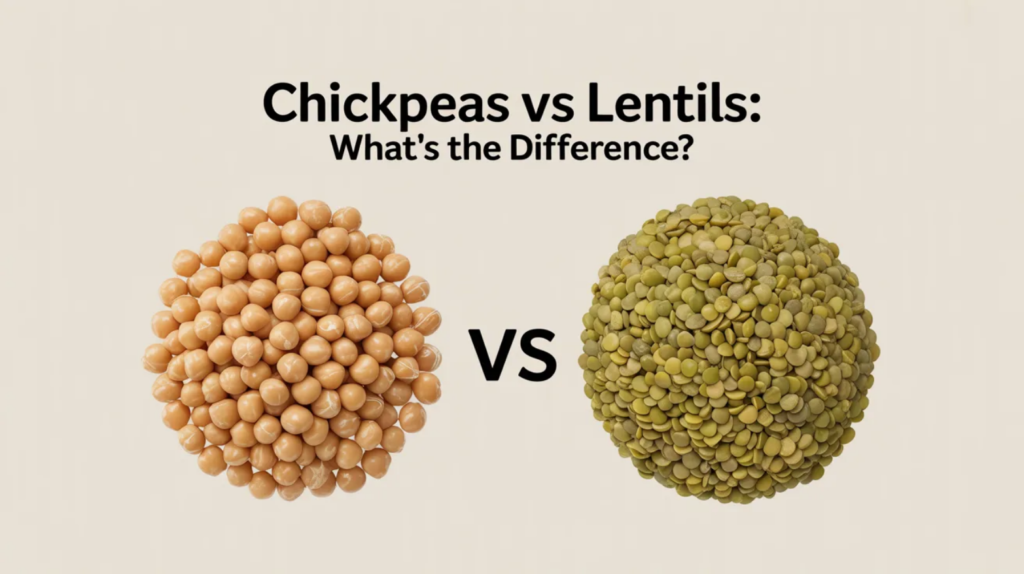
For everyday grocery buying in Britain, the clearest difference is that chickpeas stay firmer and more structured, while lentils vary by type and can either hold their shape or break down quite quickly.
The basic difference between chickpeas and lentils
Chickpeas are round, larger, and more solid than lentils. In UK supermarkets, they are most often sold in tins, jars, pouches, or dried packs, and they are usually chosen for salads, curries, traybakes, and blended dishes such as houmous. On the shelf, chickpeas are generally treated as a distinct staple because their size and firmness make them suitable for meals where the pulse needs to stay clearly visible.
Lentils are much smaller and flatter. They are usually sold dried or ready cooked, and the type makes a big difference. Red lentils soften and break down quickly, while green lentils usually stay firmer. Because of that, lentils cover a broader range of textures than chickpeas do.
How they look on supermarket shelves
In UK supermarkets, chickpeas are commonly stocked in the tinned vegetables or beans section, often close to kidney beans, butter beans, and mixed beans. Dried chickpeas are also sold in larger stores, especially in world foods sections or budget pantry ranges.
Lentils appear in more than one part of the shop. Dried red and green lentils are often found with rice, pulses, and cupboard ingredients, while tinned lentils or microwave pouches may sit near beans or convenience-led pantry items. This supermarket layout reflects the fact that lentils are sold in more forms depending on how quickly shoppers want to use them.
Texture is one of the biggest differences
Texture is where the gap between chickpeas and lentils becomes much clearer.
Chickpeas usually stay firm even after cooking. Tinned chickpeas are soft enough to eat straight away, but they still keep their shape well in curries, salads, and roasted dishes. That firmer texture is part of why they are often used in recipes where the pulse needs to stand out rather than disappear into the sauce.
Lentils behave differently depending on the variety. Red lentils soften quickly and often break apart, which makes them useful for soups, dhal, and thick sauces. Green lentils are firmer and hold together better, so they work more like a distinct ingredient in salads, side dishes, and warm bowls. In practice, chickpeas are usually more consistent in texture, while lentils are more varied.
The flavour is not quite the same
Chickpeas have a mild, slightly nutty flavour and a denser bite. Their taste is subtle enough to take on stronger seasonings, which is why they work well in spiced dishes, tomato-based sauces, and blended dips.
Lentils also have a mild flavour, but it is often earthier. Red lentils tend to feel softer and more neutral once cooked down, while green lentils keep a more noticeable pulse-like character. The difference is not dramatic, but it affects how each one fits into a meal. Chickpeas often add body and shape, while lentils often contribute thickness or a more integrated texture.
They are used differently in cooking
For shoppers in the UK, the easiest way to separate chickpeas and lentils is by thinking about the kind of dish being made.
Chickpeas are commonly used in curries, salads, traybakes, stews, and houmous. Their structure makes them useful in meals where the pulse should remain whole.
Lentils are used in soups, dhal, shepherd’s pie-style fillings, stews, and warm salads. Red lentils are often chosen when a softer, thicker finish is needed, while green lentils are used when the pulse should stay intact.
That is why replacing one with the other does not always work. A chickpea will not melt into a soup the way a red lentil will, and a red lentil will not give the same bite as a chickpea in a salad.
Preparation and cooking time are also different
Tinned chickpeas are ready to use once drained and rinsed, while dried chickpeas usually need soaking and a longer cooking time. That makes the tinned format especially popular in UK supermarkets, where convenience often shapes buying decisions.
Lentils are generally quicker and easier to prepare. Many dried lentils, especially red lentils, do not need soaking and cook faster than dried chickpeas. Green lentils take longer than red lentils, but they are still usually less demanding than dried chickpeas.
This is where the difference matters most for meal planning. Chickpeas are often chosen in ready-cooked form for convenience, while lentils are more commonly bought dried because they are already relatively quick to prepare.
Which one is more versatile in UK supermarkets?
Both are versatile, but they are versatile in different ways.
Chickpeas are versatile across cold and hot meals because they hold their shape so well. They can go into salads, curries, wraps, soups, and blended dips without losing their identity.
Lentils are versatile because different types do different jobs. Red lentils are useful for thickening and softening into a dish, while green lentils are better for structure. In that sense, lentils may cover more cooking styles overall, but only when the shopper understands which lentil type they are buying.
Which is more common on UK shelves?
In most UK supermarkets, both are easy to find, but tinned chickpeas and dried red lentils are especially common. Those two products suit everyday British meal habits because they are convenient, affordable, and easy to store.
Larger supermarkets usually offer a wider lentil range, including green lentils, puy-style lentils, and ready-cooked lentil pouches. Chickpeas, by contrast, are usually sold in fewer variations, but they are stocked very consistently across both large supermarkets and smaller convenience branches.
Conclusion
The difference between chickpeas and lentils comes down to shape, texture, cooking behaviour, and use. Chickpeas are larger, firmer, and better when the pulse needs to stay whole in the dish. Lentils are smaller, quicker to cook, and more varied, with some types holding their shape and others breaking down into a softer texture.
For UK shoppers, chickpeas are often the choice for salads, curries, and houmous, while lentils are more often chosen for soups, dhal, and dishes where texture changes during cooking. Once that distinction is clear, it becomes much easier to choose the right pulse on supermarket shelves.