
GroceriesReview.co.uk provides independent reviews and recommendations. Some pages contain affiliate links to Amazon.co.uk, and we may earn a commission when you make a qualifying purchase at no extra cost to you.
Dried pasta looks simple once it is packed and stacked on supermarket shelves, but getting it into that stable cupboard form takes a controlled manufacturing process. Before it reaches UK shops, pasta has to move from soft dough with a relatively high moisture level to a firm, dry product that can be stored for months without refrigeration.
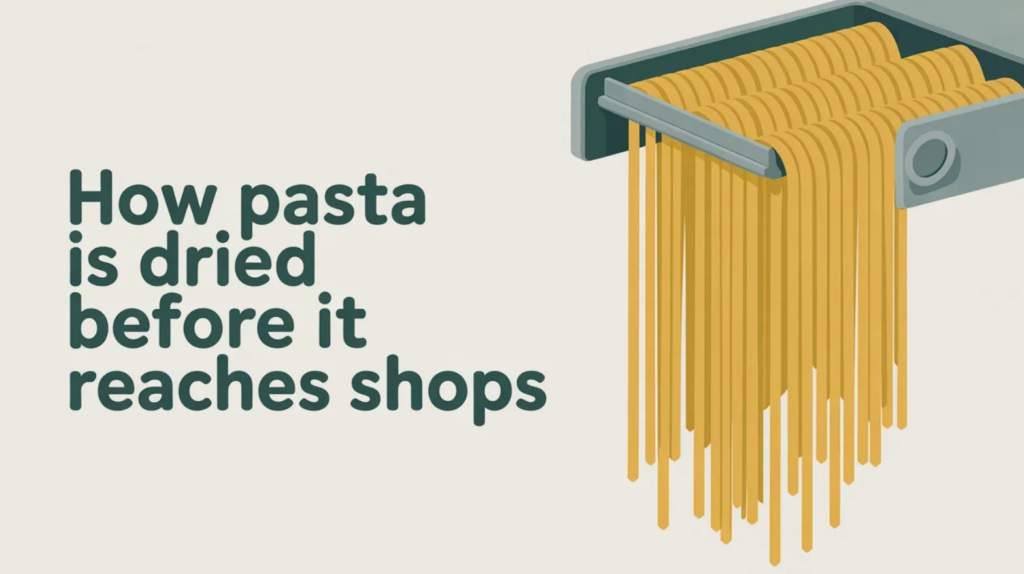
That drying stage is one of the main reasons dried pasta behaves differently from fresh pasta. It affects shelf life, texture, breakage, cooking performance, and even how premium or basic a pasta may feel once it is cooked.
Drying starts after the pasta is shaped
Before pasta can be dried, it first has to be mixed and formed. Most standard dried pasta sold in UK supermarkets is made from durum wheat semolina and water. Those ingredients are turned into a dough, then pushed through dies to create shapes such as spaghetti, penne, fusilli, or macaroni.
At that point, the pasta is still soft and contains far too much moisture for cupboard storage. If it were packed immediately, it would not stay stable on the shelf. So once the shape has been formed and cut, the pasta moves into a drying stage designed to remove much of that water in a controlled way.
The aim is to remove moisture without ruining the shape
Drying pasta is not just a matter of making it hard. The real goal is to reduce the moisture level evenly enough that the pasta stays safe and shelf-stable while still keeping its structure.
If pasta dries too quickly on the outside, the surface can harden before the centre has dried properly. That can lead to cracking, uneven texture, or weakness in the finished product. If it dries too slowly or is not dried thoroughly enough, it will not keep well.
This is why pasta manufacturers use carefully managed drying systems rather than simply leaving pasta out to air dry in an uncontrolled way.
Industrial drying usually happens in temperature-controlled chambers
In modern pasta production, the shaped pasta is normally transferred into drying chambers or tunnels where heat, airflow, and humidity can be controlled. The exact setup varies by factory and product type, but the principle stays much the same.
Warm air is circulated around the pasta so moisture gradually leaves the dough. The process may take several hours, and in some cases longer, depending on the shape, thickness, and style of pasta being made. Thin strands such as spaghetti behave differently from thicker or more compact shapes, so drying times are not identical across the whole category.
The pasta does not go from soft to fully shelf-ready in one instant step. It is usually dried in phases so the moisture can come down steadily rather than too aggressively.
Why the drying speed matters
Drying time can influence the character of the finished pasta. In broad terms, faster high-temperature drying is common in large-scale production because it is efficient and consistent. Slower drying at lower temperatures is sometimes associated with premium pasta ranges, where brands may present it as part of a more traditional or quality-focused process.
For shoppers, the important point is not that one method is always good and the other always bad. It is that drying is part of what shapes the final texture. A pasta that has been dried in a way that preserves structure well may cook with a firmer bite and a cleaner surface. A cheaper pasta can still work perfectly well for everyday meals, but the finish may not feel exactly the same as a premium line claiming slower drying or a more careful process.
That difference is not always obvious from the front of the pack, though some brands do mention slow drying on UK packaging.
Different shapes need different handling
A long strand of spaghetti and a tube of penne do not dry in quite the same way. Shape affects airflow, thickness, and how easily moisture escapes.
Long pasta is often dried hanging or laid in ways that help it keep straightness and avoid sticking. Short pasta shapes are usually dried in bulk systems suited to their size and density. More intricate shapes can need particular care so edges do not become too brittle before the centre has dried enough.
This helps explain why dried pasta is a broad supermarket category rather than one completely uniform product. Even before packaging, different shapes have already been handled slightly differently in production.
Drying is what turns pasta into a cupboard product
Fresh pasta and dried pasta begin with similar basic ideas, but drying creates the biggest practical divide between them. Once enough moisture has been removed, dried pasta becomes suitable for long shelf life and ambient storage.
That is why dried pasta sits in the grocery aisle in UK supermarkets, while fresh pasta stays in chilled cabinets. The difference is not just branding or placement. It comes from the manufacturing process itself.
For everyday shopping, this matters because dried pasta is built for flexibility. It can be stored in the cupboard, bought in larger quantities, and kept on hand for quick meals without needing refrigeration.
The pasta has to cool and stabilise before packing
After drying, pasta is not always packed immediately while still warm from the process. It usually needs to stabilise and cool so condensation does not form inside the packaging.
That stage matters because trapped moisture would undo much of the work of drying. A dry product needs dry packaging conditions too. Once the pasta has reached the right state, it can be weighed, packed, sealed, and prepared for transport to distribution centres and then on to supermarket shelves.
By the time shoppers see it in a bag or box, the key drying work has already been completed long before the product enters the retail supply chain.
What drying changes for the shopper
The drying process affects more than storage life. It also influences how the pasta behaves in boiling water. Dried pasta needs to reabsorb water during cooking, which is why it takes longer to cook than fresh pasta. It also tends to hold a firmer structure, especially in shapes used for pasta bakes, thicker sauces, and family meals.
Drying also makes the product more robust for transport, although pasta can still break if handled roughly. This is particularly noticeable with spaghetti, where long brittle strands can snap more easily than short shapes.
So even though shoppers do not see the drying stage directly, they experience its effects in cooking time, cupboard storage, texture, and pack durability.
What labels may hint at the drying process
Most supermarket packs do not explain the full production method in detail, but some premium ranges refer to slower drying, traditional methods, or bronze-die shaping. Those are usually quality signals rather than full technical descriptions.
The average own-label dried pasta may not say much beyond ingredients and cooking time, yet it has still gone through a controlled drying process to make it shelf-stable. Premium lines are simply more likely to turn that process into part of the product story on the packaging.
For UK shoppers, this means the drying method is often present in the background even when it is not heavily advertised.
Conclusion
Before pasta reaches shops, it is dried in a controlled manufacturing process that removes moisture from the freshly shaped dough and turns it into a stable cupboard product. That drying stage usually happens in managed chambers using heat and airflow, with timing adjusted according to the pasta shape and production method.
The result is the dried pasta seen in UK supermarkets: firm, shelf-stable, and ready to be boiled at home. Although shoppers mainly notice the finished pack, the drying process is one of the main reasons dried pasta stores well, cooks the way it does, and feels different from fresh pasta once it reaches the plate.