
GroceriesReview.co.uk provides independent reviews and recommendations. Some pages contain affiliate links to Amazon.co.uk, and we may earn a commission when you make a qualifying purchase at no extra cost to you.
In the UK, “artisan bread” usually means a style of loaf rather than a strict promise about ingredients. Supermarkets use the word to suggest bread that feels closer to bakery bread: a stronger crust, a more rustic shape, a less uniform crumb, and often a deeper aroma.
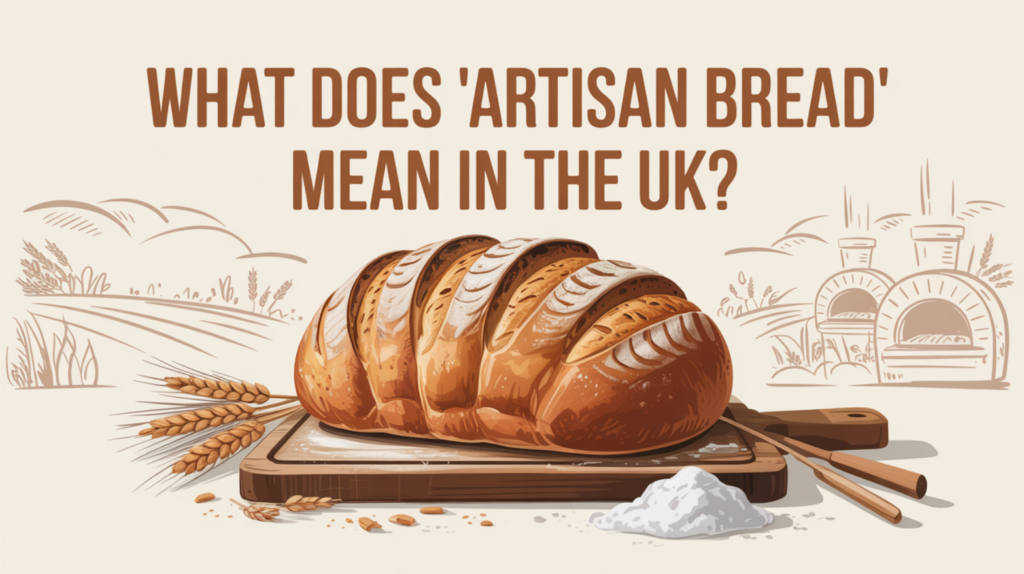
That’s why two artisan loaves can be totally different. One might be a genuinely slow-made loaf with a strong crust and a satisfying chew. Another might simply be an “artisan-style” loaf that looks rustic but behaves more like standard packaged bread once you taste it.
So the real question is not “Is artisan better?”, it’s what kind of artisan loaf are you actually buying?
What “artisan” typically signals on UK supermarket shelves
When UK retailers label a loaf as artisan (or artisan-style), it usually points to one or more of these features:
- Rustic appearance: oval or round loaves, flour-dusted tops, scored crust
- More crust: a firmer outer layer that feels bakery-like
- Less uniform crumb: uneven holes, slightly chewy texture
- Bolder flavour: not always sour, but often less bland than everyday sliced loaves
This is why artisan bread often ends up living in the “weekend loaf” role, while the softer everyday white slices stay in the weekday lunch routine.
What “artisan” does not guarantee
This is where shoppers get caught:
It doesn’t guarantee sourdough
Many people assume artisan = sourdough. In the UK, they’re different labels. Sourdough points to fermentation style, while artisan points to look and eating style. If you specifically want that tang and chew, you’re better off choosing from sourdough bread options in the UK rather than relying on the word “artisan”.
It doesn’t guarantee “handmade”
Even if it looks rustic, it can still be factory-produced. That doesn’t automatically make it bad, but it does mean “artisan” isn’t a craft certificate.
It doesn’t guarantee a short ingredient list
Some artisan-style loaves still use ingredients that help with softness or shelf life. The loaf can still be tasty; it just means the word “artisan” is about presentation and texture, not purity.
How artisan bread usually behaves at home
If you buy artisan bread and it feels “right”, these are the signs:
1) Better with butter (and simple toppings)
Because artisan-style loaves have more crust and flavour, they often make plain butter taste more satisfying, like your kitchen just became a small café for two minutes.
2) It shines with soup and hearty meals
A crustier loaf is ideal when you want bread to stand up to a bowl of soup or stew. A soft sliced loaf can work, but it won’t give the same dipping experience.
3) It can be trickier for sandwiches
Some artisan loaves make brilliant sandwiches; others are too crusty or too irregular. If you need neat lunchbox sandwiches daily, you may be happier sticking with a reliable brown loaf or a softer sandwich-style bread.
A 10-second shopper checklist (use this in the aisle)
If you’re picking between artisan loaves in a UK supermarket, glance at:
- Crust feel: does it look like it will be crisp, or soft and thin?
- Shape: round/oval rustic loaves usually eat differently than sliced tin loaves
- Slice practicality: do you need neat slices or are you happy tearing it?
- Freshness plan: artisan loaves can stale faster if left open, so buy it when you’ll actually use it
- Your goal: toast? soup? sandwiches? (choose the loaf for the job)
If you want a wider overview of how artisan fits among other supermarket bread types, the guide on UK supermarket bread categories makes it easier to match loaf style to meal style.
“Artisan” vs “Sourdough” vs “Wholemeal” (simple difference)
| Term on the pack | What it’s mainly describing | What it changes most |
|---|---|---|
| Artisan | Style + texture + look | Crust, crumb, eating experience |
| Sourdough | Fermentation style | Tang, chew, toast behaviour |
| Wholemeal | Flour type | Wheaty flavour, firmness, consistency |
If you like a dependable daily loaf but want a bit more “proper bread” feeling, some people rotate between a wholemeal loaf (steady, predictable) and an artisan-style loaf (more satisfying with meals). If your household already enjoys wholemeal, wholemeal options in the UK can make that weekday anchor loaf easy to choose.
When artisan bread is genuinely worth buying
Artisan bread usually makes the most sense when:
- you’re eating it fresh (same day or next day)
- you want bread to be part of the meal, not just a carrier
- you’re pairing it with soup, cheese, eggs, or a warm dinner
It’s less ideal when:
- you need perfectly uniform slices for school lunches
- you want a loaf that stays soft for days without effort
Practical storage note (so it doesn’t go sad overnight)
Artisan-style loaves often lose their “magic” if they’re left exposed. If you’re not finishing it quickly:
- keep it wrapped (not loosely on the counter)
- consider slicing and freezing part of it early
- revive it by toasting or warming (many artisan loaves feel great again once heated)
For a full, step-by-step approach that reduces waste, the next article How to Store Bread at Home Properly will cover this in a more complete, UK-kitchen way.